
Guide
Buying an e-bike: the 10 most important criteria
Motor position, watt-hours, frame size – buying an e-bike bombards you with jargon. This guide sorts out what really matters so you find a bike that suits your journeys.
Updated 7 min readEditorial team woebike.de
1. Purpose: what do you need the e-bike for?
Before you compare spec sheets, answer one question: where and how often will you ride? For short trips in town, a city e-bike with a low step-through is ideal. If you commute 15 kilometres or more a day and go touring at the weekend, a trekking e-bike will serve you well. There are e-mountain bikes for forest tracks and trails, and folding e-bikes for train commuters and campers.
The wrong type of bike is hard to fix later – an e-MTB stays impractical in everyday use, a city bike is out of its depth off-road. So take the most time over this decision.
2. Pedelec or S-pedelec?
Almost all e-bikes in Germany are legally pedelecs: the motor only assists while you pedal and only up to 25 km/h, with a continuous rated power of no more than 250 watts. Pedelecs count as bicycles – no insurance plate, no driving licence, no compulsory helmet.
S-pedelecs assist up to 45 km/h and are classed as mopeds (Kleinkrafträder). You need an insurance plate, at least an AM class licence and a suitable helmet, and you usually may not use cycle paths. For most people, a normal pedelec is therefore the right choice.
3. Motor position: front, rear or mid
A front motor sits in the front wheel hub. It is cheap and simple, but tends to spin on slippery surfaces and is rare today. A rear motor in the rear wheel hub pushes strongly, needs little maintenance and is typical of budget city, trekking and fat bikes.
A mid-drive motor sits at the bottom bracket and drives via the chain. It uses the gears, keeps the centre of gravity low and usually works with a torque sensor that adapts assistance to how hard you pedal. The ride feels more natural as a result – but the chain and sprockets wear faster.
4. Torque and sensor
Motor power on pedelecs is limited to 250 W continuous rated power, so motors differ mainly in torque. 40 to 50 Nm is enough for flat routes; 60 to 85 Nm helps on steep climbs and with luggage.
The sensor is just as important. A simple cadence sensor switches the motor on as soon as the cranks turn – it feels like a push from behind. A torque sensor measures how hard you pedal and meters the assistance proportionally.
5. Battery: watt-hours, not marketing promises
Battery capacity in watt-hours (Wh) is the most important figure for range. If the spec sheet only gives volts and amp-hours, simply calculate: volts × Ah = Wh. 36 V × 13 Ah gives about 470 Wh. Range claims such as “up to 100 km”, on the other hand, are hardly comparable, because every manufacturer assumes different conditions.
A removable, lockable battery is practical: you can charge it indoors and store it somewhere warm in winter.
E-bikes with a large battery
Ad All products linked with "View offer" are commission (affiliate) links: if you buy through them, we earn a commission – the price stays the same for you. As an Amazon Associate and eBay Partner Network affiliate we earn from qualifying purchases. Learn more
 Ad
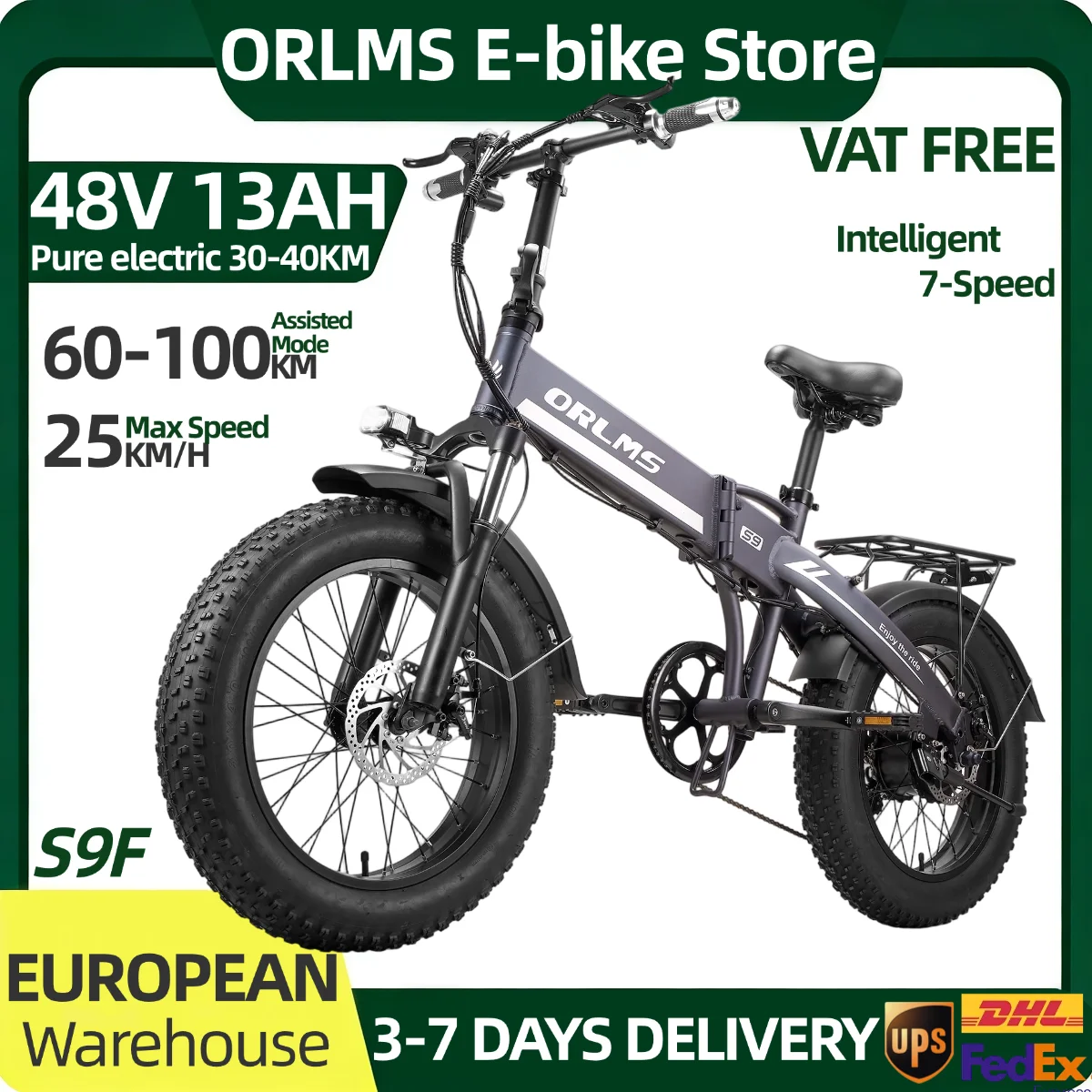
AdOrlms S9F 48V 13Ah Elektrofahrrad für Erwachsene, 20*4 Zoll Reifen …
 Ad
Ad Ad
Ad Ad
Ad6. Frame shape and frame size
A frame that is too big or too small spoils any e-bike. Frame size (RH, Rahmenhöhe) is given in centimetres and depends on your inside leg. Manufacturers publish size charts – use them rather than just looking at wheel size.
Diamond frames are stiff and sporty, trapeze frames a compromise, and step-throughs especially comfortable to get on and off. With heavy e-bikes in particular, a low step-through is a real comfort gain in everyday use.
7. Brakes and tyres
E-bikes are heavier and on average faster than normal bicycles. Hydraulic disc brakes have therefore become standard: they brake powerfully, are easy to modulate and work reliably even in the wet. Mechanical disc brakes are common at entry level and need adjusting more often.
For tyres, puncture protection and e-bike approval (often marked “E-25”) are worthwhile. Wider tyres add comfort but cost a little range.
8. Gears and drivetrain
Derailleur gears with 7 to 12 speeds are light and efficient but need care. Hub gears are sealed, can be shifted while stationary and suit city and trekking bikes well. A belt drive almost completely eliminates chain oiling – but can only be combined with hub or gearbox systems.
9. Weight, equipment and everyday practicality
Most e-bikes weigh between 20 and 30 kg. If you have to carry the bike into the cellar or lift it onto a bike rack, every kilo counts. Also check the permitted total weight: rider, bike and luggage together must not exceed it.
- Road-legal lights (StVZO), ideally powered directly from the battery
- A rack with sufficient load capacity
- Mudguards, kickstand, bell
- Push assist up to 6 km/h for ramps and stairways
- Display showing battery level and remaining range
Popular trekking e-bikes for everyday use
Ad All products linked with "View offer" are commission (affiliate) links: if you buy through them, we earn a commission – the price stays the same for you. As an Amazon Associate and eBay Partner Network affiliate we earn from qualifying purchases. Learn more
Ad Ad
Ad Ad
Ad Ad
Ad10. Service, warranty and spare parts
An e-bike is a technical product that needs maintenance. Ask before buying: is there a workshop that knows the system? Will you still be able to get a replacement battery in a few years? Who offers software updates and diagnostics? With brands using widespread drive systems this is usually no problem; with direct imports without European service, even a faulty controller can mean a write-off.
Regardless of the manufacturer, when buying from a commercial retailer in Germany you have a two-year statutory warranty (Gewährleistung). Many manufacturers also give a longer guarantee on the frame; separate conditions often apply to the battery.
Budget e-bikes at a glance
Ad All products linked with "View offer" are commission (affiliate) links: if you buy through them, we earn a commission – the price stays the same for you. As an Amazon Associate and eBay Partner Network affiliate we earn from qualifying purchases. Learn more
 Ad
AdE-Bike Herren Damen, 14 Zoll Elektrofahrrad, 250W, Leichtbau & Klappbar …
 Ad
AdXphenine Klappbares City E-Bike mit App-Steuerung Max 50Km Reichweite
 Ad
AdLookRun G11 Klappbares Elektrofahrrad 48V 400W 7.8AH Akku 14 Zoll kompakt …
 Ad
AdLOOKRUN 14" Elektrofahrrad 400W 48V 7,8AH E-Fahrrad ebike Faltbar E-MTB 25 …
Bonus: test ride and handover
If possible, test-ride at least two different models before buying – ideally one with a rear motor and one with a mid-drive. You'll quickly notice which ride feel you prefer and whether the riding position suits you. Choose a route with a climb and a few starts from standstill, because that's exactly where the differences show.
If you buy online, the bike usually arrives 90 to 95 percent pre-assembled. You have to fit the handlebars, pedals and sometimes the front wheel or saddle yourself. Afterwards, check all bolts to the specified torque, test the brakes and fully charge the battery before the first ride. If you don't trust yourself with the assembly, a bike workshop will do it for a modest fee – money well spent, because badly adjusted brakes on a heavy e-bike are a real safety risk.
After about 200 to 300 kilometres, a first check-up makes sense: spokes settle, cables stretch and bolts can loosen. After that, one service a year is enough for most riders, ideally before the start of the season.
Common bad buys – and how to avoid them
Most bad buys aren't caused by a bad bike, but by an unsuitable one. A classic is the sporty e-mountain bike that ends up only being used to pop to the bakery – without mudguards, lights or a rack. Just as common: the cheap direct-import bike with an impressive spec sheet, for which nobody is responsible after the first fault.
A third typical mistake is looking only at maximum range. A huge battery is of little use if it makes the bike so heavy that you can no longer get it into the cellar. So be honest about which journeys you actually ride, and buy for that everyday reality – not for the one big tour a year.
Conclusion: how to find your e-bike
Start with the purpose, then decide on frame shape and size, and only then compare motor, battery and equipment. Look for honest spec sheets – watt-hours instead of kilometre promises, 250 W and 25 km/h instead of “power motor”. And use the price history: e-bike prices in particular fluctuate considerably over the year, and with a little patience you'll save noticeably on the same model.
FAQ
How much should a good e-bike cost?
That depends on how you'll use it. Simple city pedelecs are available at entry level, trekking e-bikes with a mid-drive usually cost considerably more, and good e-mountain bikes more again. What matters is that the motor, battery and brakes suit your routes.
Is a mid-drive motor always better?
Not always. For flat city routes, a rear motor is cheap, low-maintenance and perfectly adequate. On hills and with luggage, the mid-drive shows its strengths.
Should I buy an e-bike online or from a dealer?
Online, the choice is bigger and often cheaper. A specialist dealer gives you advice, a test ride and service. If you buy online, find out in advance where you can have services and repairs done.
What is a good battery size?
400–500 Wh for town and short commutes, 600–750 Wh for longer tours and hilly country.