
Guide
How to charge, care for and store your e-bike battery
The battery is the most expensive component of your e-bike. With a few simple charging and storage habits it will last considerably longer – and stay safe.
Updated 7 min readEditorial team woebike.de
How an e-bike battery works
Almost all e-bikes use lithium-ion batteries made up of many individual cylindrical cells (often type 18650 or 21700). A battery management system (BMS) monitors the voltage, temperature and charging current of each cell group and protects against overcharging and deep discharge.
Capacity is given in watt-hours (Wh). Over time, all lithium-ion batteries lose capacity – through charge cycles, but also simply through ageing. How quickly that happens depends heavily on how you charge and store them.
Charging correctly day to day
Modern batteries have no memory effect. So you can top up at any time, even if the battery is only half empty. For a long service life it's actually better not to run the battery completely flat all the time and not to leave it at 100 percent permanently.
- Only use the original charger or one approved by the manufacturer
- Charge at room temperature – not below about 0 °C and not in blazing sun
- After a winter ride, let the battery warm up first, then charge it
- Charge on a non-flammable surface in a room with a smoke alarm
- Don't leave it on the charger permanently if the bike stands unused for weeks
How far will I get? Estimating range realistically
As a rule of thumb, a pedelec uses 7 to 15 Wh per kilometre. A 500 Wh battery is therefore enough for about 35 to 70 kilometres – more in eco mode on the flat, less in turbo mode on hills.
You can influence the range yourself: pedal at a higher cadence in an easier gear, use the lowest assistance level that feels comfortable, keep tyre pressure within the recommended range and avoid constantly accelerating from a standstill. Luggage and headwinds also cost energy.
E-bikes with long battery range
Ad All products linked with "View offer" are commission (affiliate) links: if you buy through them, we earn a commission – the price stays the same for you. As an Amazon Associate and eBay Partner Network affiliate we earn from qualifying purchases. Learn more
 Ad
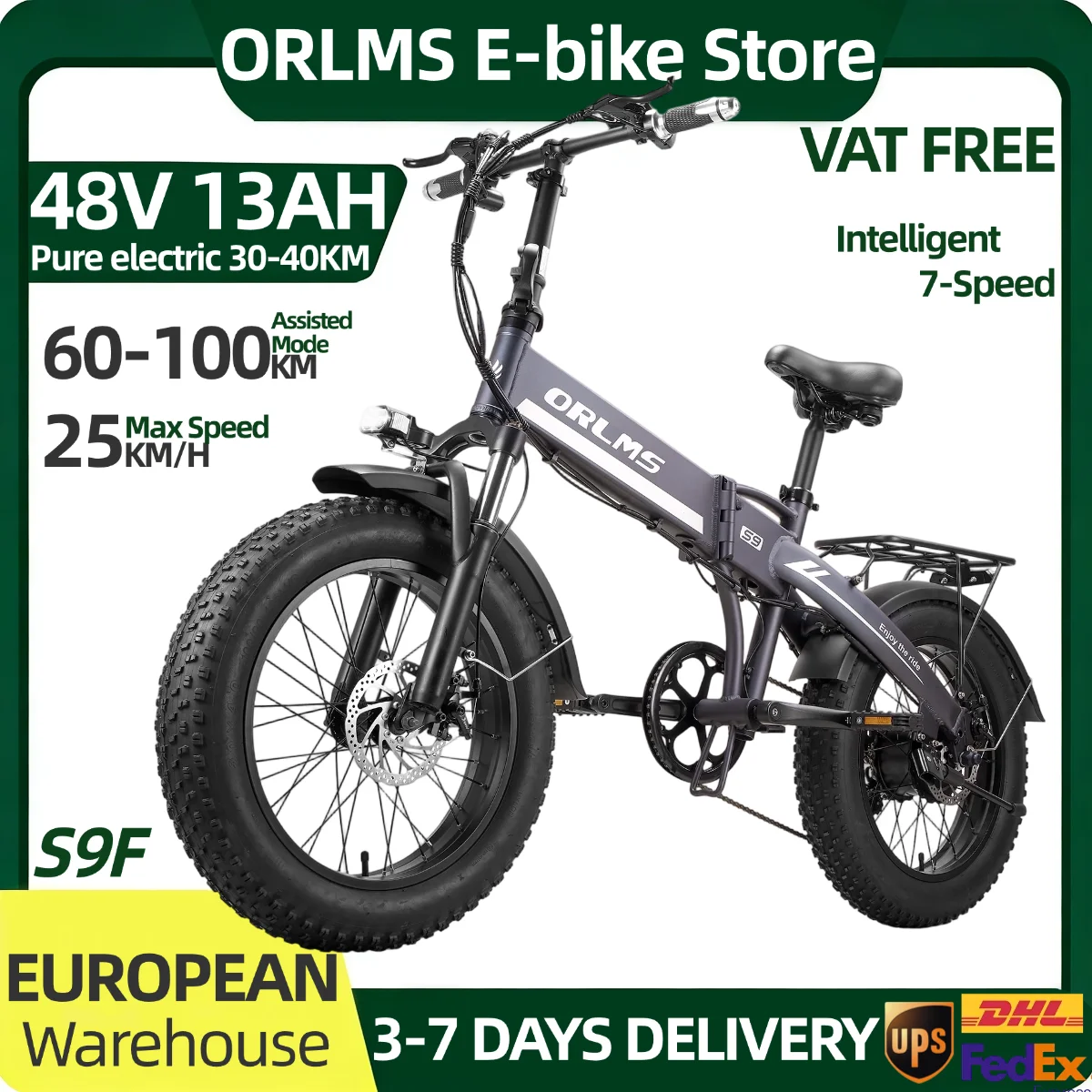
AdOrlms S9F 48V 13Ah Elektrofahrrad für Erwachsene, 20*4 Zoll Reifen …
 Ad
Ad Ad
Ad Ad
AdStoring the battery over winter: how to do it right
If you ride little or not at all in winter, correct storage is crucial. During storage, cold harms the battery less than heat, but very low temperatures and an empty battery are a bad combination.
- Remove the battery from the bike and store it dry at about 10 to 20 °C
- Bring the charge level to about 30 to 60 percent – not full, not empty
- Check the charge level every 4 to 8 weeks and top up if necessary
- Keep the contacts clean and dry
- Don't store it in the car, in the loft or in an unheated garden shed
Riding in the cold
At low temperatures a battery delivers less energy – range can drop considerably in winter. That's not a defect, it's chemistry. So keep the battery indoors overnight and only fit it shortly before riding. Neoprene thermal covers help maintain the operating temperature on longer rides.
Safety: recognising warning signs
Lithium-ion batteries are safe when handled correctly. However, damage from falls, water or the wrong charger can lead to overheating. Take the battery out of use immediately if the casing is cracked, bulges, gets unusually hot, smells or hisses.
Avoid cheap copies without test certification and modifications in which cells or the BMS are replaced – unless done by specialist workshops. For transport and storage there are fire-retardant battery bags that offer an extra safety margin.
Replacement batteries compared
Ad All products linked with "View offer" are commission (affiliate) links: if you buy through them, we earn a commission – the price stays the same for you. As an Amazon Associate and eBay Partner Network affiliate we earn from qualifying purchases. Learn more
![E-Bike Akku Schutzhülle, [Für 28-45 Cm Rahmenumfang] …](https://i.ebayimg.com/images/g/xkwAAeSw9CpqulOF/s-l225.jpg)


When is a new battery due?
A battery doesn't suddenly die; it gradually gets weaker. Many manufacturers define end of life at around 60 to 70 percent of the original capacity. As long as the range is enough for you, you don't need to do anything. If it gets too tight, you have three options: buy an original replacement battery, choose a tested compatible battery or have the cells replaced at a specialist workshop.
Old batteries don't belong in household waste. Retailers that sell batteries and municipal recycling centres take them back free of charge.
Caring for contacts, lock and mount
Besides the cells themselves, everything around them needs a little attention too. The contacts between battery and mount should be clean and dry. You can clean dirty contacts with a dry cloth or a soft brush; only use contact spray if the manufacturer approves it. The battery lock will appreciate a drop of lock oil, especially after riding in the rain or on gritted roads in winter.
Wash your e-bike with a bucket, sponge and garden hose at low pressure. Pressure washers can force water into connectors, bearings and the motor. Remove the battery for washing and cover the contacts on the bike.
Charging on the go and at the office
Many commuters top up their battery at work. That's straightforward if your employer allows it and the charger is in perfect condition. Choose a spot where the battery isn't right next to flammable materials, and don't charge it in a closed cupboard. On tours you can recharge at many cafés, inns and public charging points – a second charger in your luggage makes you more independent.
Fast chargers shorten charging time but put more strain on the cells. For everyday use, the standard charger is the gentler choice.
Myths about e-bike batteries
Stubborn misconceptions persist around batteries. The most important: new batteries don't need to be “broken in” or fully discharged several times. That made sense with old nickel-cadmium batteries, but with lithium-ion batteries it does more harm than good. Equally wrong is the assumption that a battery is better off in the cellar in winter just because it's cool there – damp and very cold rooms are unfavourable.
Another myth concerns charge cycles: one cycle corresponds to a full charge from 0 to 100 percent. Charging twice from 50 to 100 percent therefore only counts as one cycle in total. Frequent topping up is therefore no problem.
Checklist for the off-season
Before you put your e-bike away for the winter, a short routine helps: clean and dry the bike, oil the chain, inflate the tyres to the recommended pressure, charge the battery to about half and remove it. If possible, remove the display too and store it with the battery indoors. Put a date in your calendar to check the charge level.
In spring, fully charge the battery before the first ride and take a short test ride, checking brakes, lights and gears. If the battery shows considerably less range after the break than in autumn, a battery test at a specialist workshop is worthwhile – many systems can be read out with diagnostic software.
Volts, amp-hours, watt-hours – briefly explained
The voltage in volts (usually 36 or 48 V) must match the motor and says little about range. Amp-hours (Ah) describe the amount of charge. Only the product of the two, watt-hours (Wh), shows how much energy is in the battery: 36 V × 14 Ah gives around 500 Wh, and 48 V × 10.4 Ah also about 500 Wh. Two batteries with different voltages but the same number of watt-hours will therefore take you about the same distance.
The most important tip to finish
Treat the battery like a valuable tool: don't drop it, don't overheat it, don't leave it standing empty. Follow these three rules and a long service life comes almost automatically.
FAQ
Should I always fully charge my e-bike battery?
For everyday riding and tours, yes, if you need the range. For service life, it's better not to leave the battery at 100 percent or completely empty for weeks.
Can I store the battery in a cold cellar?
Short term yes, but better not for the winter break. Ideal conditions are dry, 10 to 20 °C and a charge level of 30 to 60 percent.
How long does charging take?
With standard chargers, usually 3 to 6 hours for a full charge, depending on capacity and charging current.
Can I ride with the battery in the rain?
Yes, e-bike batteries are protected against splashing water. But don't submerge the bike or clean it with a pressure washer.
Why is range lower in winter?
In the cold, the chemical processes in the battery slow down and it can deliver less energy. Storing the battery somewhere warm and using a thermal cover help.